China Fast Train:
Live Status, Schedule, Routes and Tickets
Ask which train in China is actually the fastest and you’ll get two different answers depending on who you ask. Rail enthusiasts will point you to the Shanghai Maglev, floating along at 431 km/h on its short hop out to Pudong Airport. Everyone else, meaning the hundreds of millions of people who actually ride the network every year, means the Fuxing bullet trains that connect basically every major city on 350 km/h track. Both are correct answers to “what’s the china fast train,” just answering slightly different questions. This page covers both, along with the routes, ticket prices, and a couple of things about this network that genuinely surprised us while researching it. Curious how any of these numbers stack up globally? Our train speed test puts them side by side with Japan, France and everywhere else.
The Maglev Question
Let’s get this out of the way first since it confuses almost everyone. The Shanghai Maglev is not part of China’s regular high speed rail network. It’s a separate system entirely, using magnetic levitation instead of wheels on rails, and it only runs one route: Longyang Road station to Pudong International Airport, about 30 km, done in under eight minutes. At 431 km/h it’s the fastest train on Earth in actual passenger service today, faster than anything running in Japan or France. But you can’t use it to get anywhere except that one airport connection. If you’re picturing a china fast train that crosses the country at that speed, that train doesn’t exist yet, the network everyone actually travels on tops out around 350 km/h.
What the Real Network Looks Like
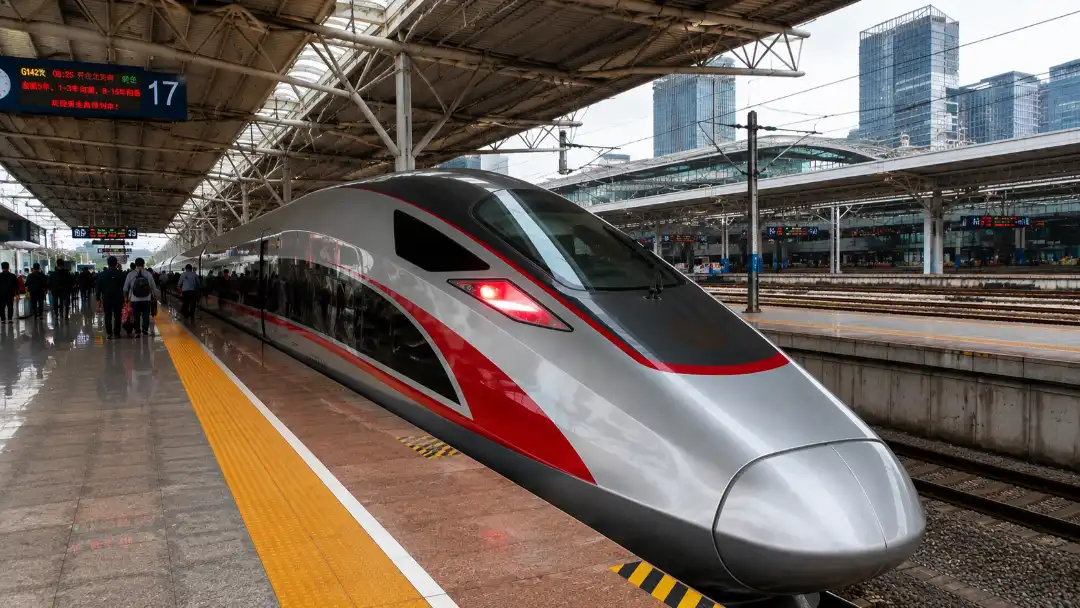
Take the maglev out of the picture and you’re left with Fuxing, the standard bullet train that covers over 40,000 km of dedicated track, more than every other country’s high speed network combined.
Beijing to Shanghai is the one everyone’s heard of, roughly 1,300 km covered in about four and a half hours, a trip that used to take the better part of a day. You can check your own speed against the posted 350 km/h using the speedometer online if you want proof it’s not exaggerating.
Beijing to Xi’an cuts a similarly dramatic figure. What used to be a ten-hour slog is now about four and a half hours, which matters given how many people travel there to see the Terracotta Army on a weekend trip rather than a week-long one.
Shanghai to Hangzhou barely counts as a journey by comparison, under an hour, and it runs so frequently it functions more like a very fast commuter line between two of eastern China’s biggest economic hubs than a long distance trip.
Not Just the Wealthy Coast
One thing that doesn’t get mentioned enough: high speed rail in China isn’t a coastal-cities-only story. Chengdu to Chongqing, two major inland cities in the southwest, takes about an hour on the fast train. Kunming, further southwest still, connects onward to Dali and Lijiang on lines built specifically to open up Yunnan’s tourism economy. Beijing to Harbin pushes the network into the northeast, through territory that gets genuinely brutal winters, and the trains still run.
Crossing the Border
Guangzhou to Shenzhen, then onward into Hong Kong West Kowloon, is the one route on this page that actually crosses an international border, sort of, depending on how you categorize Hong Kong. Either way, it’s under an hour from Shenzhen and it’s the clearest example of how far China’s high speed ambitions now reach beyond the mainland. The China-Laos Railway is a newer, less talked about example of the same instinct, a line built to connect Kunming down into Laos, part of a broader pattern of China extending rail infrastructure into neighboring countries rather than stopping at its own borders.
The One That Isn’t About Speed
The Qinghai-Tibet Railway doesn’t belong on a “fastest trains” list at all, and we’re including it anyway because it’s too interesting to skip. It’s the highest railway in the world, climbing past 5,000 meters as it connects Xining to Lhasa, engineered for altitude and permafrost rather than raw speed. Carriages are pressurized like an aircraft cabin. It’s the opposite kind of achievement from a 350 km/h bullet train, but it’s still one of the most remarkable things China’s built on rails.
Checking Status Before You Travel
China Railway’s official 12306 site and app cover live status for everything on this page except the maglev, which has its own separate operator and status system given it’s a different piece of infrastructure entirely. Weather causes most delays, typhoons along the southern and eastern coast, snow further north, though the density of the network generally means a delay on one line doesn’t ripple across the whole system the way it might somewhere smaller.
Booking, Ticket Classes and What It Actually Costs
Tickets go on sale 15 days before departure through 12306, the only official channel, and it’s worth booking early since Beijing-Shanghai and a handful of other flagship routes sell out fast around Chinese national holidays. Most Fuxing services split into Second Class, First Class and Business Class, with Business Class offering meaningfully wider seats and priority boarding, similar in spirit to airline classes rather than a typical train’s first class. Cost varies a lot by distance and class, but as a rough sense, Beijing to Shanghai in Second Class runs a fraction of what a flight costs, while Business Class narrows that gap considerably.
Schedule and Route Finder
If you’d rather just pick a route and see stops, timings and fare ranges directly, use the tool below.
Train schedule and route finder
Pick a country and route to see stops, timings and booking links.
Stops and stop to stop times
| Station | From origin | Typical departure |
|---|
Sample daily departures
| Departs | Arrives | Duration |
|---|
Coverage here centers on the Fuxing bullet train network as the primary china fast train service, with the Shanghai Maglev included separately given how differently it operates.
Why Gatimaan and Vande Bharat Are Still Capped Below Global High Speed Standards
Neither train is limited by its own technology so much as by the track it runs on. Most of India’s rail network, including the stretches Gatimaan and Vande Bharat use, is shared conventional track built for a mix of freight and passenger traffic, not dedicated high speed lines built from scratch the way Japan’s Shinkansen or Spain’s AVE network were. That’s the same story told across nearly every country on this site that hasn’t invested in dedicated infrastructure.
Where This Sits Globally
|
Country |
Fastest Train |
Top Speed |
|---|---|---|
|
China |
Shanghai Maglev |
267 mph (431 km/h) |
|
Japan |
L0 Series Maglev (testing) |
374 mph |
|
France |
TGV |
357 mph |
|
Spain |
AVE |
193 mph |
|
Germany |
ICE |
190 mph |
|
USA |
Brightline West (in progress) |
186 mph |
|
UK |
Southeastern Highspeed Javelin |
140 mph |
|
Canada |
VIA Rail |
100 mph |
|
India |
Gatimaan Express |
99 mph (160 km/h) |
|
Australia |
Queensland Tilt Train |
99 mph (160 km/h) |
China’s china fast train tops this list for anything actually running scheduled passenger service today, edged only by Japan’s maglev, which is still in testing rather than commercial use.
What Is Coming Next
Extensions keep pushing the network into less connected western and inland provinces, and the international angle keeps growing too, more rail links planned into Southeast Asia following the same logic as the Laos line, plus continued freight rail connections toward Europe through Central Asia for cargo rather than passengers. China has floated hyperloop concepts publicly, though nothing has moved past early testing, so treat that as a “maybe eventually” rather than anything close to real. For a deeper dive into how the high speed network itself developed, our full guide on high speed rail in China covers the history and technology in more detail.
A Few Things Worth Knowing Before You Ride
Arrive with at least 30 minutes to spare for security, standard at every major station here the way it is at an airport. You’ll need a passport or ID both to book and to board, checked against your ticket at the gate, so don’t expect to buy a ticket for someone else without their documents. Bringing your own food is completely normal and common, though plenty is also sold on board if you’d rather not bother.
Conclusion – China Fast Train
There isn’t one single answer to what counts as the china fast train, and that’s really the point. The Shanghai Maglev holds the outright speed record at 431 km/h, but it only connects an airport to a city center. The Fuxing network, running up to 350 km/h across more than 40,000 km of dedicated track, is what actually moves the country, from Beijing and Shanghai down to inland cities like Chengdu and Chongqing, and now across the border into Hong Kong and beyond. Add in outliers like the high altitude Qinghai-Tibet line, and China’s rail system covers more ground, in more different ways, than any other network on this site. Whichever route you’re planning, book early through 12306, arrive with time for security, and the rest of the trip tends to run exactly on schedule.